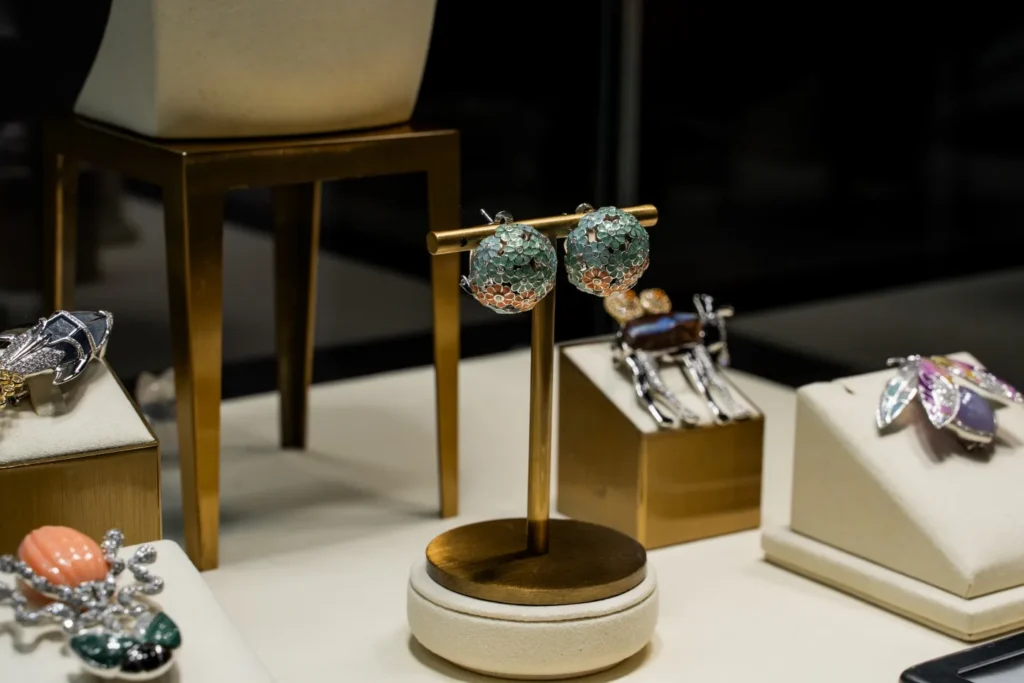


At this year’s SEMICON Taiwan, a 50-carat CVD-grown diamond drew particular attention on the exhibition floor.
At first glance, diamonds and semiconductors belong to two distinctly different industries—jewellery and technology. Yet the two intersect through a shared focus on materials. From the arrangement of carbon atoms to the colours of gemstones, and from crystal structures to the ways in which different materials are layered, the composition and structure of a material often determine the properties it ultimately exhibits.
Looking at jewellery through the lens of materials also brings us back to a fundamental question: where does the beauty of a piece of jewellery truly come from?

A Gemstone’s Colour Is More Than Meets the Eye
In jewellery, colour is often the first thing that catches the eye. The rich red of ruby, deep blue of sapphire and vivid green of emerald may seem purely visual, but their colours are closely linked to their chemical composition and crystal structure.
Trace elements within a gemstone can affect how it absorbs specific wavelengths of light, while crystal lattice defects can also influence its optical properties.
Different compositions, structures and formation conditions can therefore produce distinct colours and optical effects. What we see is ultimately the result of how light interacts with the material.
The beauty of a gemstone is not simply added to the material—it is inherent in it.

From Natural Formation to Precision Manufacturing
Diamonds offer another fascinating example.
Both diamond and graphite are made of carbon, yet their different atomic bonding and spatial arrangements give them completely different physical properties. Diamond’s three-dimensional crystal structure gives it exceptional hardness and thermal conductivity. CVD (Chemical Vapor Deposition) diamonds, meanwhile, are produced through a controlled process in which carbon gradually forms crystals on a diamond seed.
From minerals shaped by geological processes over millions of years to modern technologies that precisely control crystal growth, our understanding of gemstone materials has expanded from discovery to research, production and application.
This does not diminish the natural origins of gemstones. Instead, it highlights how the same material can take different forms and serve different purposes.
From Material to Jewellery, a Journey of Creation
Yet material is only the starting point.
Different cutting proportions, facet designs and polishing techniques can bring out different levels of brilliance and lustre in the same gemstone. Combined with metal, setting techniques and creative vision, the material can be transformed into an entirely different piece of jewellery.
From natural gemstones to lab-grown diamonds, and from traditional craftsmanship to contemporary design, the jewellery industry continues to explore the relationship between materials, technology and aesthetics.

From Materials to the 2026 Taiwan Jewellery & Gem Fair
From material composition and crystal structure to the finished piece, materials are fundamental to jewellery design and craftsmanship.
Taking place 20–23 November 2026 at Taipei World Trade Center Hall 1, the fair brings together jewellery brands, designers, gemstone and mineral specialists, manufacturers and professional buyers.
From natural minerals and crystals in GemVerse to the creative interpretations of materials and craftsmanship in the Designer Zone, discover how materials are transformed into jewellery through design and craft.
Visit the 2026 Taiwan Jewellery & Gem Fair and explore the connection between materials, craftsmanship and contemporary jewellery design.
Note: This article references insights from the feature article “Not Just Jewellery! Lab-Grown Diamonds Unlock New Possibilities for AI Chips” published by our media partner, Jewellery World, and has been edited and adapted by the Taiwan Jewellery & Gem Fair editorial team
Original Author: Judy Tu, GG / FGA / FGG / SGC